Lay Kelly Staking Plan
A very good explanation of Kelly Betting for back and lay can be found here – Kelly Criterion – Part 3a – Backing and Laying Bets with Betfair.
One of the problems we have with any kelly betting is what to use as our edge.
For help on calculating layers edge please view : https://thestakingmachine.com/how-do-we-calculate-layers-edge/
There are 2 ways of looking at lay kelly staking.
- It is the reverse of Back Kelly. So if your fraction to bet in the back kelly calculation is negative. This becomes your lay kelly fraction to bet. The kelly formula is telling you that if you were to place a back bet there is no value in doing so. However if you were to place a lay bet there would be value in doing so.
- It can be calculated from the lay equivalent of the back kelly formula.
| Back Kelly Formula f* = bp – q / b Lay Kelly Formula f* = q-(p*b) / b |
| where f* is the fraction of the current bankroll to wager; b is the current bet odds (fractional); p is the probability of winning; q is the probability of losing, which is 1 − p. |
Once the fraction to bet is known it can then be divided by our divisor if we have one. The next stake can then be calculated. At this point you must decide whether you are going to use f* to use as your stake OR your liability.
So for
Stake = fraction to bet * Bank Total
or
Liability = fraction to bet * Bank Total
In which case your stake is then calculated according to the liability.
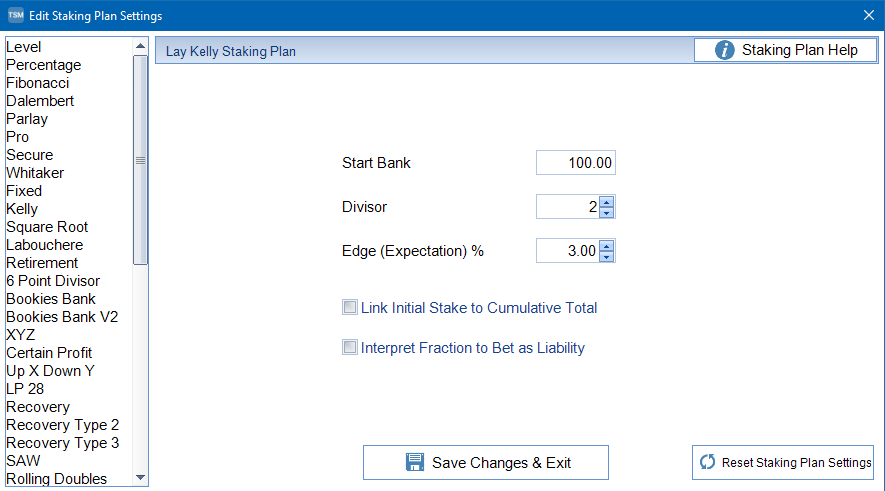
In TSM you can choose either option. You can also choose whether your Total Bank is fixed or a cumulative total.
Frequently Asked Questions
Answer: The Lay Kelly Staking Plan is the lay version of the Kelly Criterion. It calculates the optimal fraction of your current bank to use as either the stake or the liability based on your estimated edge. It automatically compounds as the bank grows and reduces exposure when the bank shrinks.
Answer:
- Start Bank – Your initial betting bank
- Kelly Divisor – Safety factor (e.g. 2 = Half Kelly, 4 = Quarter Kelly)
- Use as Stake or Use as Liability – Choose whether the calculated fraction applies to stake or liability
- Fixed or Cumulative Bank – Use starting bank or current running total
Answer: Back Kelly uses the standard formula for backing bets. Lay Kelly is the reverse – it is used when you believe there is value in laying a selection. If the back Kelly fraction is negative, it often indicates a good lay opportunity.
Answer: It works well for users who can accurately estimate their edge/probability on each selection. It is more advanced and volatile than flat or simple percentage plans, so it suits experienced users with strong-performing lay systems.
Answer: It is more aggressive and growth-oriented than conservative plans like Lay Level or Lay Fixed Liability. It offers excellent compounding potential but carries higher risk if your edge estimates are inaccurate.
Answer: Most users start with a Divisor of 2 (Half Kelly) or higher for safety. Full Kelly (Divisor = 1) is very aggressive and can lead to large drawdowns.